Why the 80s Vision of the Future Is Still Cooler Than Today's
Axel Robellada
Pop culture of fun, lifestyle, creativity, excess, and rebellion wrapped in neon lights
The Legacy of the Future Past
The future used to be cooler. Not necessarily more convenient, or faster, or smarter. Just... cooler. Anyone who grew up in the '80s knows: we were promised a tomorrow of flying cars, LED-lit leather jackets, and epic synth soundtracks. That vision, drenched in neon and chrome, still resonates today with surprising force.
The future of the 80s didn't predict TikTok or self-driving electric cars, but it left us with something much more lasting: a sense of aesthetic possibility.
While our present is defined by minimalist efficiency and algorithmic invisibility, the 1980s future was bold, loud, and tangible. It was a future you could see, touch, and feel. Let's break down why that retrofuturistic vision remains an unsurpassed cultural touchstone.
The Future as Aesthetics: Neon, Chrome, and Synthetic Dreams
In the 1980s, the future wasn't anticipated, it was designed. Artists and filmmakers constructed a visually stunning tomorrow with tools we would now consider primitive. Early CGI graphics, like the wire hands that appeared out of nowhere in music videos, weren't about realism, but about creating something entirely new and exciting. Films like Tron (1982) and Blade Runner (1982) didn't just tell stories; they created entire aesthetic universes that defined the cyberpunk genre.
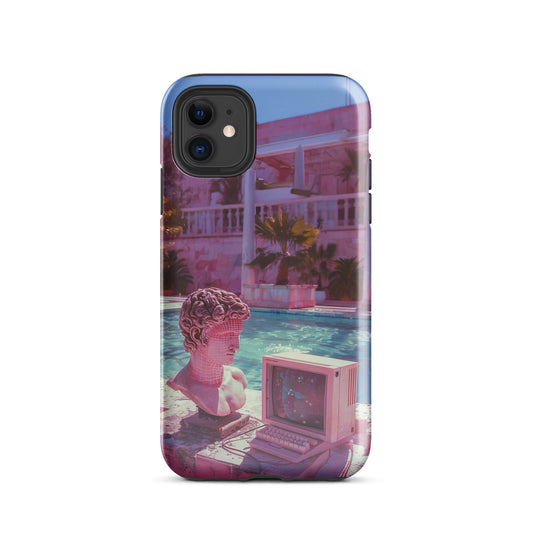
This aesthetic was composed of highly recognizable elements: laser grids stretching to infinity, chrome surfaces reflecting neon lights, and rainy cities where kanji flickered like digital ghosts. It wasn't a prediction, it was a mood board. It was a declaration that the future could be dark, yes, but with impeccable style.
Tangible Technology: The Charm of Analog
The technology of the 80s had weight, texture, and presence. It wasn't an ethereal cloud of data, but a physical object you interacted with. Think of the ritual of inserting a VHS tape into the player, the satisfying click of a Walkman's buttons, or the hum of a CRT monitor as it turned on. Loading a program from a floppy disk made you feel like a hacker about to infiltrate the network.
These devices were noisy, personality-filled companions. They blinked, buzzed, and got warm. They demanded deliberate interaction. Today, technology is fluid and frictionless, optimized for productivity but stripped of almost all its character. The convenience of tapping a screen has replaced the romance of turning a dial. When was the last time your smartphone made you feel great just by holding it?
Imperfection was part of the charm. The scan lines on the screen, the VHS distortion, or the graphical glitches weren't errors, but textures that gave the experience soul. They were proof that you were interacting with a machine, a portal to another world built with wires and circuits, not just abstract code.
Futuristic Fashion: Dressing for a Bold Tomorrow
Before Nordic minimalism and functional sportswear became the global uniform, futuristic 80s fashion was a statement. It was bold, geometric, and daring. Wide shoulder pads weren't just a trend; they were corporate armor. Shiny high-top sneakers looked like they were designed for walking on the walls of a space station. Mirrored sunglasses not only protected you from the sun but also transformed you into an anonymous, enigmatic cyborg.

Clothing was a language. A neon windbreaker screamed "hacker on the run," while a worn leather jacket identified you as a bounty hunter with a heart of gold. It wasn't about subtlety, but about amplifying your identity. It was about dressing for the adventure the future promised, a world yet to be tamed where your attire was your first line of defense and your best calling card.
Soundscapes and Urban Landscapes: The Soundtrack of Tomorrow
No futuristic fantasy from the '80s is complete without its soundtrack. Analog synthesizers created dense, immersive atmospheres, with pads floating like cosmic jellyfish and drums with thunderous reverb. The music wasn't mere accompaniment; it was the soul of the scene. Vangelis's work on Blade Runner is the perfect example: his melancholic and majestic melodies are as iconic as the film's cityscapes themselves.
This sound, known today as synthwave, has experienced a massive resurgence in recent decades, fueled by soundtracks from films like Drive (2011) and series like Stranger Things. This return isn't mere nostalgia; it's a reconnection with a time when electronic music sounded epic, emotional, and profoundly human. The resurgence demonstrates a yearning for a future that felt vibrant and brimming with sonic possibilities.
Unwavering Optimism, Even in Dystopia
Perhaps the most fascinating aspect of the 1980s future is that, even in its darkest visions, there was an underlying optimism. Sure, the world might be ruled by an evil megacorporation like OCP in RoboCop (1987) or the Tyrell Corporation, but at least you had a hoverboard or an awesome jacket. There was a fundamental belief that technology, despite its dangers, could transform life into something more exciting.
The corporations of that era were honest villains. Their headquarters were monolithic ziggurats that dominated the skyline, unmistakable symbols of power. They didn't hide behind user-friendly interfaces or endless terms and conditions. Their evil was visible, almost theatrical. Today, power is more subtle and omnipresent. The future of the 1980s didn't know surveillance capitalism; your Walkman didn't filter your musical tastes to advertisers. The future was a playground, not a data farm.

Conclusion: The Legacy of the Future Past
So why does the future of the '80s still seem cooler? Because it had soul. It wasn't obsessed with perfection, comfort, or efficiency. It was chaotic, melancholic, loud, and above all, it had an unmistakable attitude. It was a world where a boombox could be a weapon of self-expression and a denim jacket meant you were ready for whatever the neon horizon threw at you.
That vision hasn't disappeared. It's been bottled, remixed, and resurrected in retrowave and synthwave culture. It's a reminder that the future doesn't have to be cold, beige, and predictable. It can be bright, strange, and bold. It can, ultimately, be cool again.